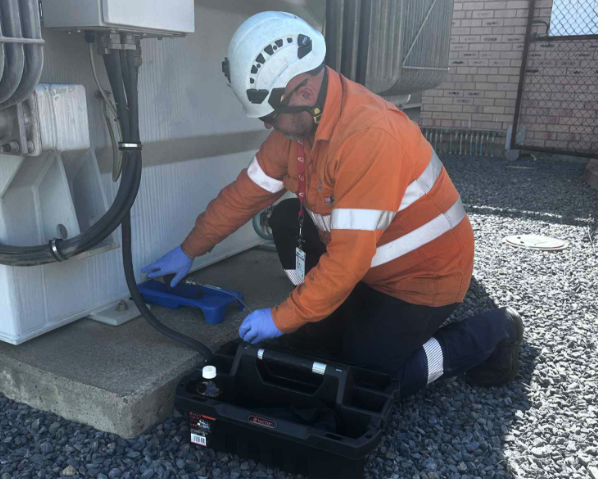
In transformer diagnostics, the conversation often centres on advanced analysis techniques, interpretation methods, and laboratory capability. Yet the most critical factor influencing the accuracy of any result occurs much earlier—at the point of oil sampling. Dissolved Gas Analysis (DGA) can only ever be as reliable as the sample provided, and if that sample is compromised, every downstream decision is at risk. Controlling how oil is taken from equipment is essential for ensuring diagnostic confidence, protecting plant integrity, and maintaining operator safety.
The Overlooked Weak Point in Oil Sampling
Standards such as IEC and ASTM provide guidance on how oil samples should be taken, including the use of syringes, bottles, and handling practices. However, one key area often overlooked is the physical connection to the transformer. In real-world conditions, technicians are required to work with a wide variety of valves, flanges, and fittings. This leads to the use of shared connector kits, which are rarely cleaned between samples.
These connector kits may be used across dozens of transformers and OLTCs, often stored in workshops and reused without proper cleaning. The assumption is that flushing oil through the system will remove contaminants, but in reality, residual oil, sludge, and dissolved gases remain trapped in threads and fittings, creating a major source of cross contamination.
Cross Contamination: A Major Source of Error
Cross contamination is far more common than many engineers realise. Even trace amounts of residual oil can introduce gases such as acetylene or hydrogen into a new sample. Given that DGA operates at parts-per-million (ppm) levels, these small contaminations can completely distort results.
Comparing 10 ppm to finding 10 coloured dots in a million illustrates how difficult ppm levels are to visualise. In this context, even a tiny amount of carryover from a previous sample can trigger false diagnostics. The sources of contamination are numerous: dirty connectors and fittings, residual oil in sampling tubes, contaminated gloves or cloths, and gasket or flange residue.
According to industry sources, the number of false positives caused by contamination is "astounding". This can lead to incorrect conclusions about transformer condition, unnecessary maintenance, or even missed faults.
The Importance of Repeatability
Repeatability is essential for DGA trending. Without consistent sampling conditions, it becomes impossible to determine whether changes in gas levels are due to actual transformer behaviour or simply variations in the sampling process.
Controlled sampling trials have demonstrated this clearly. Once a controlled sampling method was introduced, gas levels began to "flatten out," indicating stable and repeatable results. In one case, acetylene—which had previously appeared in results—completely disappeared after eliminating cross contamination. This confirmed that earlier readings were not representative of the transformer condition.
This highlights a critical point: poor sampling can make a healthy transformer appear faulty, while good sampling can reveal the true condition without any physical intervention.
The Trans-Sample Coupling Solution
To address these issues, the Trans-Sample Coupling was developed as a dedicated, permanently installed sampling interface. Unlike traditional methods, this coupling remains attached to the transformer for its entire service life, eliminating the need for shared connectors.
A key design feature is that during connection, trapped air is forced out of the coupling, leaving only a minimal volume (approximately 6–10 mm³). This ensures that air does not enter the transformer during sampling—a critical safety and quality improvement.
Additionally, the system incorporates sealed mating surfaces to prevent contamination, non-return valve systems to stop air ingress under vacuum, controlled flushing paths to ensure representative samples, and dust caps and protective seals to prevent environmental contamination.
The coupling also ensures that even if a technician makes an error—such as removing the sampling hose before closing the valve—no oil is lost and no air enters the system.
Safety and Operational Benefits
Beyond data quality, the system significantly improves safety. Transformers under vacuum can draw in air when valves are opened, potentially leading to insulation failure or flashover. Traditional methods, such as the "slug method," still allow air ingress and rely heavily on operator speed and skill.
The Trans-Sample system eliminates this risk by maintaining a sealed environment at all times. This protects both the equipment and the technician, removing a critical hazard from the sampling process.
Cost and Efficiency Gains
While the primary goal is improved sample quality, there are also substantial cost and efficiency benefits. Sampling time can be reduced by more than 50%, as technicians no longer need to manage complex fittings or perform extensive flushing.
One utility reduced its sampling time from four days to two after installing the system across its network. Although initial installation increased costs by approximately 55%, these costs were recovered within a year through time savings alone.
Furthermore, poor-quality samples can lead to expensive retesting. A single bad sample can more than double the total cost—from $330 to $725—once re-sampling, additional labour, and engineering analysis are included.
Ensuring End-to-End Quality
Sampling is only one part of the overall process. Quality must be maintained from the transformer to the laboratory. This includes using glass containers instead of plastic (which degrade oil quality over time), minimising exposure to sunlight and delays in testing, and selecting laboratories capable of repeatable and timely analysis. Even with perfect sampling, poor handling or delayed testing can still compromise results.
Conclusion
Accurate DGA depends entirely on the integrity of the oil sample. Traditional sampling methods introduce significant risks through cross contamination, inconsistent connections, and operator variability.
The Trans-Sample Coupling addresses these challenges by providing a sealed, repeatable, and contamination-free sampling interface. The result is improved diagnostic accuracy, enhanced safety, reduced costs, and greater confidence in transformer condition assessments.
Ultimately, the message is clear: controlling the sampling process is just as important as the analysis itself. Without reliable samples, even the most advanced diagnostic tools cannot deliver meaningful results.